
Leaving a Flat Rate Behind: Reading a Split Fee at 2,944 TH/s
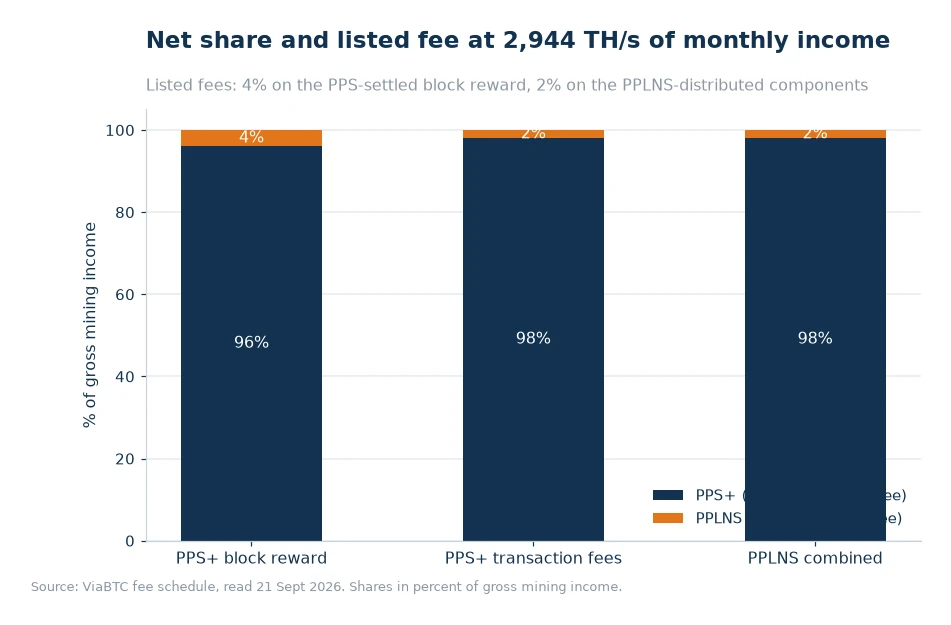
Operators who have only ever paid one percentage tend to read a split schedule as a price rise. At 2,944 TH/s the gross is about $111.85 a day, the listed 4% on the block-reward component comes to $4.47, and the listed 2% on the PPLNS-distributed components is $2.24 on the same base. Whether that is more or less than the old flat quote depends on something the old quote never had to explain.

Key takeaways
- Gross at 2,944 TH/s is $111.85 a day; the listed 4% is $4.47 and the listed 2% is $2.24 on the same base.
- A flat rate and a split rate can only be compared at the same block composition, so ask what share of income came from transaction fees.
- At a 10% fee share the split schedule behaves like 3.8%, which is below a flat 4%.
- Keep one month of statements from the old pool; they are the only evidence of what the flat rate really cost.
What a flat rate was quietly pricing
A single percentage is a promise that every component is treated the same. That is convenient for budgeting and opaque for comparison, because the pool is free to blend a cheap stream with an expensive one and present the average. When a schedule splits the rate, the blending becomes visible, and visibility feels like an increase even when the arithmetic says otherwise.
The way out is to stop comparing rates and start comparing fees in dollars for one specific month. Take the old statements, find the gross and the fee, and divide. That gives the effective rate you were actually paying, including any component the old pool priced differently. Only then does the new schedule have something honest to be measured against.
Three quotes, one month of gross
The table applies four fee structures to the same gross figure. The flat quotes are illustrative of the kind of headline an operator might be leaving; the split rows show what the same schedule produces at two different fee shares.
| Structure | Rate on gross | Fee per day | Fee per 30 days |
|---|---|---|---|
| Flat 3% | 3.00% | $3.36 | $100.67 |
| Flat 4% | 4.00% | $4.47 | $134.22 |
| Split, fees 10% of gross | 3.80% | $4.25 | $127.51 |
| Split, fees 25% of gross | 3.50% | $3.91 | $117.44 |
The split schedule lands between the two flat quotes and moves with the chain. In a busy month it beats a flat 4%; in a quiet one it converges on it. That is the honest summary, and it is more useful than either "the split is cheaper" or "the split is a rebrand of 6%".
The number that makes the comparison fair
It is the transaction-fee share of gross income, and almost nobody records it. A block's reward has a fixed subsidy component and a variable fee component; the bigger the second, the more of your income sits on the 2% line rather than the 4% line. On a quiet chain the share is small and the schedule behaves like a 4% pool. On a crowded one it is large and the blended rate falls toward 3.5% or below.
You do not need to measure it precisely to make a decision. You need to know whether it is closer to 5% or 25%, because that is the range in which the comparison actually changes. A pool's own statistics or a block explorer will give the shape of it in a few minutes. If the answer is genuinely unclear, assume a small share and compare against a flat 4%, which is the conservative reading and the one that cannot flatter the new schedule.
Worked example: the old quote against the new schedule
Put both on the same gross and see what a month costs.
- Start from 450 BTC spread over 1,003,000,000 TH/s: 0.00000044865 BTC per terahash.
- At 2,944 TH/s: 2,944 × 0.00000044865 = 0.00132072 BTC a day.
- Dollars: 0.00132072 × 84,692 = $111.85, the gross used in the chart note.
- Listed 4% on the block-reward component: 111.85 × 0.04 = $4.47.
- Listed 2% on the PPLNS-distributed components: 111.85 × 0.02 = $2.24.
- Blended at a 10% fee share: 0.04 × 0.90 = 3.60%, plus 0.02 × 0.10 = 0.20%, so 3.80% of $111.85, or $4.25 a day.
- A flat 4% would have been $4.47 a day, so the split saves 22 cents a day at this mix, or $6.60 in a 30-day month.
Twenty-two cents is small. The reason to move is rarely the fee alone; it is the settlement timing, the withdrawal terms, or the fact that the old pool charged for something the new one includes. Be clear about which of those is doing the work in your decision.
Migrating without losing a settlement cycle
Point the machines at the new pool only after the old account is clean. A final payout that arrives after the workers have moved is difficult to attribute, and it will sit in an account nobody is watching. Withdraw to a wallet you control first, then repoint, then confirm that the first shares are being credited under the worker names you expect.
Expect the first day to look slightly odd on any dashboard. PPS+ credits hourly against current difficulty, so a partial first hour produces a partial credit, and that is normal. Do not chase it as a fault. The second full day is the first fair comparison, and the third is the one to show a partner.
The habit that survives the migration
The habit worth keeping is the dollar-per-day fee line, not the percentage. Write the fee in dollars beside the gross for three months after the move, and compare it with the same three months at the old pool. If the line is lower and the uptime is the same, the migration did what it was supposed to do, regardless of how the percentages read.
The habit worth dropping is the assumption that a single number is simpler. A split schedule is more work to read once and easier to check afterwards, because each rate has a stated base. That trade is worth making at any hashrate where the fee is a real cost, which at 2,944 TH/s it certainly is.
The ViaBTC Pool Fees page states the two rates against their components, and the Statistics view gives the network context for the gross. Read both on the same day and the comparison stops depending on memory. A Profit Calculator run at 2,944 TH/s closes the loop by producing the gross the rates are applied to.
Frequently asked questions
Is a 4% and 2% split more expensive than a flat 4%?
Usually slightly less, sometimes the same. At 2,944 TH/s a flat 4% on $111.85 is $4.47 a day, while the split at a 10% transaction-fee share is 3.80%, or $4.25. The gap widens as the fee share rises.
Do I need to change anything in the miner configuration?
Only the pool address and the worker name. The fee structure is a property of the account, not the hardware, so the machines hash exactly as before and the credit rate changes because the settlement terms changed.
How long before the new fee line is comparable?
Three full days, at minimum, because the first partial day mixes two pools. A month is better. Keep the old statements for the same period, since a comparison against a remembered figure is not a comparison at all.
Compare dollars, then decide
Take last month's gross, apply both structures, and write the two monthly totals on one line each. If the difference is a few dollars, decide on settlement timing and withdrawal terms instead, because those are the parts that change how the operation runs. If the difference is material, the arithmetic has already made the case.
Sources: ViaBTC pricing and statistics pages. Rates as published on 21 Sept 2026: 4% on the block-reward component, 2% on the PPLNS-distributed components. Chain inputs read 21 Sept 2026: network hashrate 1,003 EH/s, difficulty 132.76 T, subsidy 3.125 BTC per block, BTC $84,692. Published 24 Oct 2026[1].