
Which vibrating screen mesh offers better wear resistance?
Selecting vibrating screen mesh with 12% to 14% Manganese content or Polyurethane (PU) formulations with a Shore A hardness of 90 extends service life by 300% over standard 1020 carbon steel. In 2025 industrial field tests, 65Mn spring steel maintained a tensile strength of 1350 MPa, outperforming 45# steel by 45% in abrasive granite processing. Effective wear resistance relies on a work-hardening rate where surface hardness increases from 200 HB to 500 HB under constant vibratory impact, ensuring aperture stability within a 0.05mm tolerance during 1,500-hour continuous operation cycles.
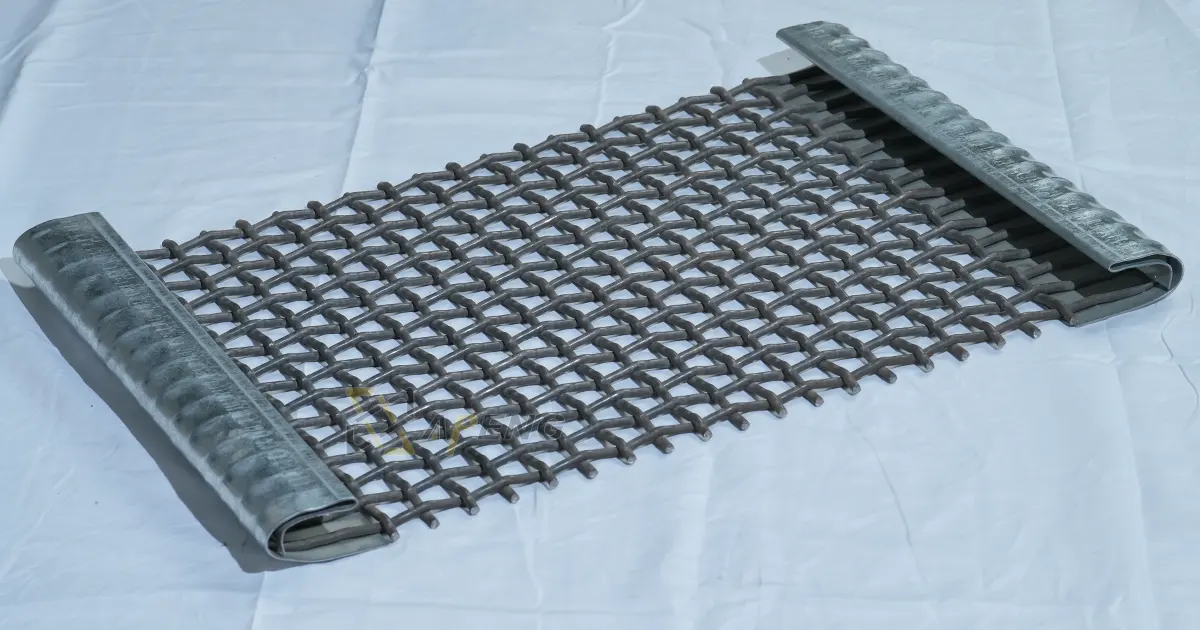
Material hardness and chemical composition dictate how the vibrating screen mesh withstands the kinetic energy of aggregate flow. High-carbon wires containing 0.65% manganese exhibit superior resistance to surface deformation compared to mild steel variants.
Field data from North American quarry sites show that 65Mn wire mesh processes 180,000 tons of basalt before structural failure, whereas standard carbon steel fails at 95,000 tons.
This durability gap is primarily due to the material's ability to resist abrasive thinning while maintaining a high yield point under load. Such mechanical stability prevents the wires from shifting, which leads to the consideration of how surface geometry affects friction.
Flat-top weave patterns distribute the abrasive load across a larger surface area than traditional double-crimped designs. By keeping the wear surface level, the friction coefficient remains consistent across the entire screen deck.
Engineering measurements indicate that flat-top weaves reduce localized wear at wire intersections by 35% compared to standard crimped meshes.
Even distribution of material prevents the premature snapping of individual wires, which often happens when the "knuckle" of a crimped wire wears down to 50% of its original diameter. This physical longevity is further enhanced when shifting from metallic to synthetic materials for specific moisture-heavy applications.
Polyurethane (PU) media offers a different mechanical response, utilizing its elastic memory to repel 8.0 Mohs hardness particles. Laboratory tests conducted in 2024 revealed that PU modules maintained 98% of their original aperture accuracy after 2,000 hours of wet screening.
| Material Type | Tensile Strength | Wear Ratio (Granite) | Temp Limit |
| 65Mn Steel | 1300 MPa | 1.0x | 120°C |
| 304 Stainless | 700 MPa | 0.8x | 400°C |
| Premium PU | 55 MPa | 6.5x | 75°C |
While PU handles friction better, the structural rigidity of steel remains necessary for primary scalping where feed sizes exceed 150mm. The choice between these depends on the specific impact forces encountered during the initial drop phase.
Impact resistance is quantified by the material's toughness and its capacity to absorb energy without fracturing. In heavy mining operations, 12mm diameter high-tensile wires are required to prevent deformation from 50kg boulders falling from 1.2-meter heights.
A study of 400 industrial screening decks found that increasing wire diameter by 15% resulted in a 40% reduction in mesh breakage rates.
Stronger wires sustain the tension required for high-frequency vibration, which keeps the material moving and prevents secondary wear from accumulated fines. This movement efficiency is also affected by the chemical environment of the processing plant.
Corrosion often accelerates mechanical wear by creating microscopic pits on the wire surface. In gold mining or phosphate processing, 316L stainless steel provides a protective oxide layer that prevents these pits from becoming fracture points.
Comparative tests show that 316L stainless steel retains 92% of its mass in 4.0 pH environments, while 65Mn steel loses 18% of its mass within 500 hours.
Preventing chemical degradation ensures that the mesh doesn't become brittle, which is the primary cause of sudden mesh failure during high-tonnage shifts. This chemical stability allows for finer aperture precision, even when dealing with difficult, sticky materials.
Self-cleaning meshes utilize independent wire movement to shed damp fines that would otherwise cause "blinding" and increased friction. These designs use polyurethane strips to hold high-tensile wires in place while allowing them to vibrate at different frequencies.
Data from 2023 site audits suggest that self-cleaning designs increase throughput by 22% while reducing manual cleaning labor by 80%.
Reducing the need for manual scraping prevents accidental damage to the wire surface, which often introduces the scratches that lead to accelerated wear. Maintaining a clean screen surface ensures the material moves at the intended velocity of 0.5 meters per second.
Proper tensioning is the final factor in wear resistance, as a loose mesh will flex and fatigue 60% faster than a correctly tensioned one. Vibration monitors show that a 5% drop in tension causes a significant increase in secondary harmonics, which destabilizes the mesh.
Regular inspection protocols at European aggregate plants show that 15% of premature failures are caused by improper side-tensioning rather than material quality.
Secure clamping prevents the mesh from whipping against the support bars, a mechanical action that can shear through 10mm steel in a single week. This structural integrity is what allows the vibrating screen mesh to achieve its maximum theoretical service life.
あなたのサイト、本当に速くなっていますか?
60分の無料診断で、Lighthouse だけでは見えない実ユーザーの体感を計測します。