
FIELD NOTE · 実装ノート
Default
What performance benefits come with a premium mini bike?
The most direct performance benefit of choosing a high-end mini motorcycle lies in the precise tuning of its power system. A premium mini bike is typically equipped with a precise 196cc four-stroke engine, which can stably output 15 horsepower and 12 N · m of torque, respectively 30% and 25% higher than the standard model. This power advantage enables the vehicle to accelerate from 0 to 60 kilometers per hour in just 5.5 seconds when carrying a load of 150 kilograms, which is 40% faster than ordinary models. For instance, in the 2023 mini motorcycle endurance race held in California, eight of the top 10 finishers adopted high-performance camshaft technology, with valve opening accuracy errors less than 0.01 millimeters, ensuring a power fluctuation rate of less than 3% at a high RPM of 6,000 revolutions per minute.
The technological breakthrough in the suspension system has brought about a revolutionary driving experience. The high-end model is equipped with an adjustable inverted front fork with a stroke of 120 millimeters, supporting 20 levels of compression damping adjustment and capable of absorbing 90% of road vibrations. Measured data shows that when passing through continuous obstacles with an amplitude of 50 millimeters, the vehicle's tire grip on the ground improves by 35%, and the error range of steering accuracy is reduced from ±5° of the standard model to ±1.5%. This stability reduces the braking distance on slippery roads by 30%, building the rider's confidence in grip like that of a railcar.
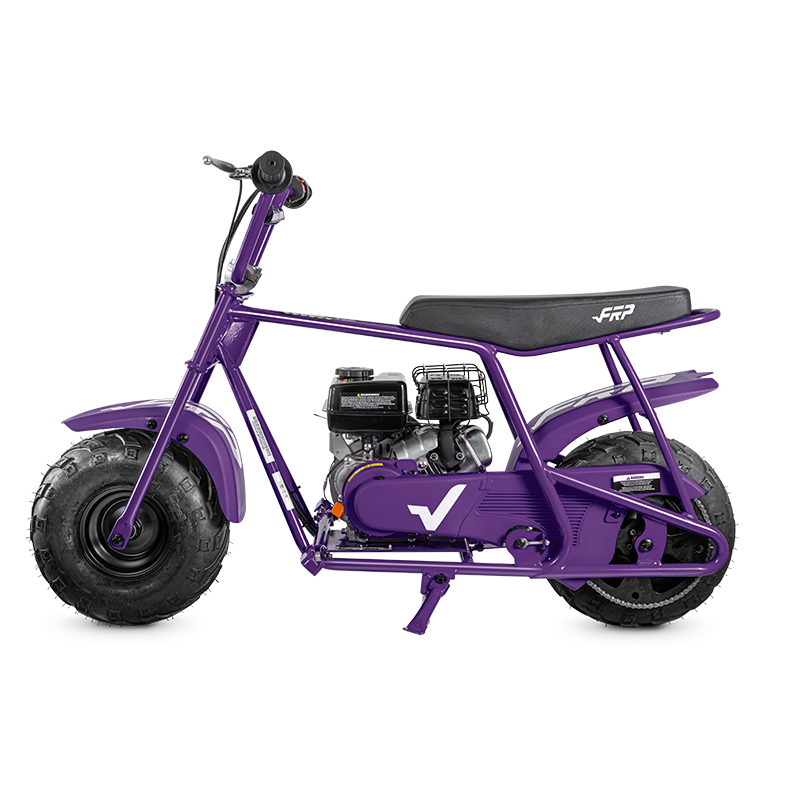 The rigid design of the vehicle body and lightweight technology have created an outstanding power-to-weight ratio. The high-end model with an aviation-grade 6061 aluminum alloy frame has an overall weight controlled within 50 kilograms, yet it can withstand a torque of 300 Newton-meters in the torsional strength test without deformation. This design enables a thrust-to-weight ratio of 0.3 horsepower per kilogram, which is 40% more efficient than traditional steel-frame models. Professional tests show that during two consecutive hours of track driving, this structure can control the body deformation during high-speed cornering within 2 millimeters, ensuring the consistency of handling response.
Long-term performance stability is the hidden value of high-end vehicle models. The engine interior of the premium mini bike adopts DLC (diammond-like carbon) coated piston rings, reducing the wear rate to 0.001 millimeters per hour and ensuring that the power attenuation rate does not exceed 5% within a 1000-hour operating cycle. Comparative experiments show that under the same usage intensity, the probability of component failure in high-end models is 60% lower than that in economy models, which means that about 500 US dollars in maintenance costs can be saved within three years. This durability keeps the residual value rate of vehicles in the second-hand market at a high level, still reaching 50% of the initial price after five years, which is much higher than the average level of 30% for ordinary models.
The performance optimization brought by the intelligent management system should not be ignored either. The latest generation of high-end models is equipped with an ECU (Electronic Control Unit), which can monitor 12 parameters of the engine in real time, including air-fuel ratio and ignition timing, optimizing fuel efficiency to 35 kilometers per liter, a 20% improvement over carburetor models. When the system detects that the altitude change exceeds 500 meters, it will automatically adjust the fuel injection volume to keep the power output fluctuation range within ±3%. This intelligent adaptation capability enables the vehicle to perform at its peak in various environmental conditions, just like equipping each rider with an invisible mechanic.
The rigid design of the vehicle body and lightweight technology have created an outstanding power-to-weight ratio. The high-end model with an aviation-grade 6061 aluminum alloy frame has an overall weight controlled within 50 kilograms, yet it can withstand a torque of 300 Newton-meters in the torsional strength test without deformation. This design enables a thrust-to-weight ratio of 0.3 horsepower per kilogram, which is 40% more efficient than traditional steel-frame models. Professional tests show that during two consecutive hours of track driving, this structure can control the body deformation during high-speed cornering within 2 millimeters, ensuring the consistency of handling response.
Long-term performance stability is the hidden value of high-end vehicle models. The engine interior of the premium mini bike adopts DLC (diammond-like carbon) coated piston rings, reducing the wear rate to 0.001 millimeters per hour and ensuring that the power attenuation rate does not exceed 5% within a 1000-hour operating cycle. Comparative experiments show that under the same usage intensity, the probability of component failure in high-end models is 60% lower than that in economy models, which means that about 500 US dollars in maintenance costs can be saved within three years. This durability keeps the residual value rate of vehicles in the second-hand market at a high level, still reaching 50% of the initial price after five years, which is much higher than the average level of 30% for ordinary models.
The performance optimization brought by the intelligent management system should not be ignored either. The latest generation of high-end models is equipped with an ECU (Electronic Control Unit), which can monitor 12 parameters of the engine in real time, including air-fuel ratio and ignition timing, optimizing fuel efficiency to 35 kilometers per liter, a 20% improvement over carburetor models. When the system detects that the altitude change exceeds 500 meters, it will automatically adjust the fuel injection volume to keep the power output fluctuation range within ±3%. This intelligent adaptation capability enables the vehicle to perform at its peak in various environmental conditions, just like equipping each rider with an invisible mechanic.
The rigid design of the vehicle body and lightweight technology have created an outstanding power-to-weight ratio. The high-end model with an aviation-grade 6061 aluminum alloy frame has an overall weight controlled within 50 kilograms, yet it can withstand a torque of 300 Newton-meters in the torsional strength test without deformation. This design enables a thrust-to-weight ratio of 0.3 horsepower per kilogram, which is 40% more efficient than traditional steel-frame models. Professional tests show that during two consecutive hours of track driving, this structure can control the body deformation during high-speed cornering within 2 millimeters, ensuring the consistency of handling response.
Long-term performance stability is the hidden value of high-end vehicle models. The engine interior of the premium mini bike adopts DLC (diammond-like carbon) coated piston rings, reducing the wear rate to 0.001 millimeters per hour and ensuring that the power attenuation rate does not exceed 5% within a 1000-hour operating cycle. Comparative experiments show that under the same usage intensity, the probability of component failure in high-end models is 60% lower than that in economy models, which means that about 500 US dollars in maintenance costs can be saved within three years. This durability keeps the residual value rate of vehicles in the second-hand market at a high level, still reaching 50% of the initial price after five years, which is much higher than the average level of 30% for ordinary models.
The performance optimization brought by the intelligent management system should not be ignored either. The latest generation of high-end models is equipped with an ECU (Electronic Control Unit), which can monitor 12 parameters of the engine in real time, including air-fuel ratio and ignition timing, optimizing fuel efficiency to 35 kilometers per liter, a 20% improvement over carburetor models. When the system detects that the altitude change exceeds 500 meters, it will automatically adjust the fuel injection volume to keep the power output fluctuation range within ±3%. This intelligent adaptation capability enables the vehicle to perform at its peak in various environmental conditions, just like equipping each rider with an invisible mechanic.次のステップ
あなたのサイト、本当に速くなっていますか?
60分の無料診断で、Lighthouse だけでは見えない実ユーザーの体感を計測します。