
How Fragrance Sample Approval Has Changed for Spa and Hotel Buyers
A buyer who last sourced fragrance five to ten years ago will find the sample approval process changed less in its steps and more in its surroundings: regulation now sets the calendar, conformity documentation arrives with the first sample, and one-stop programmes have replaced multi-factory hand-offs. The seven gates of approval are the same, but each gate now carries more paperwork and the loop between them runs faster. This article maps the changes and the one thing that has not moved.
Key takeaways
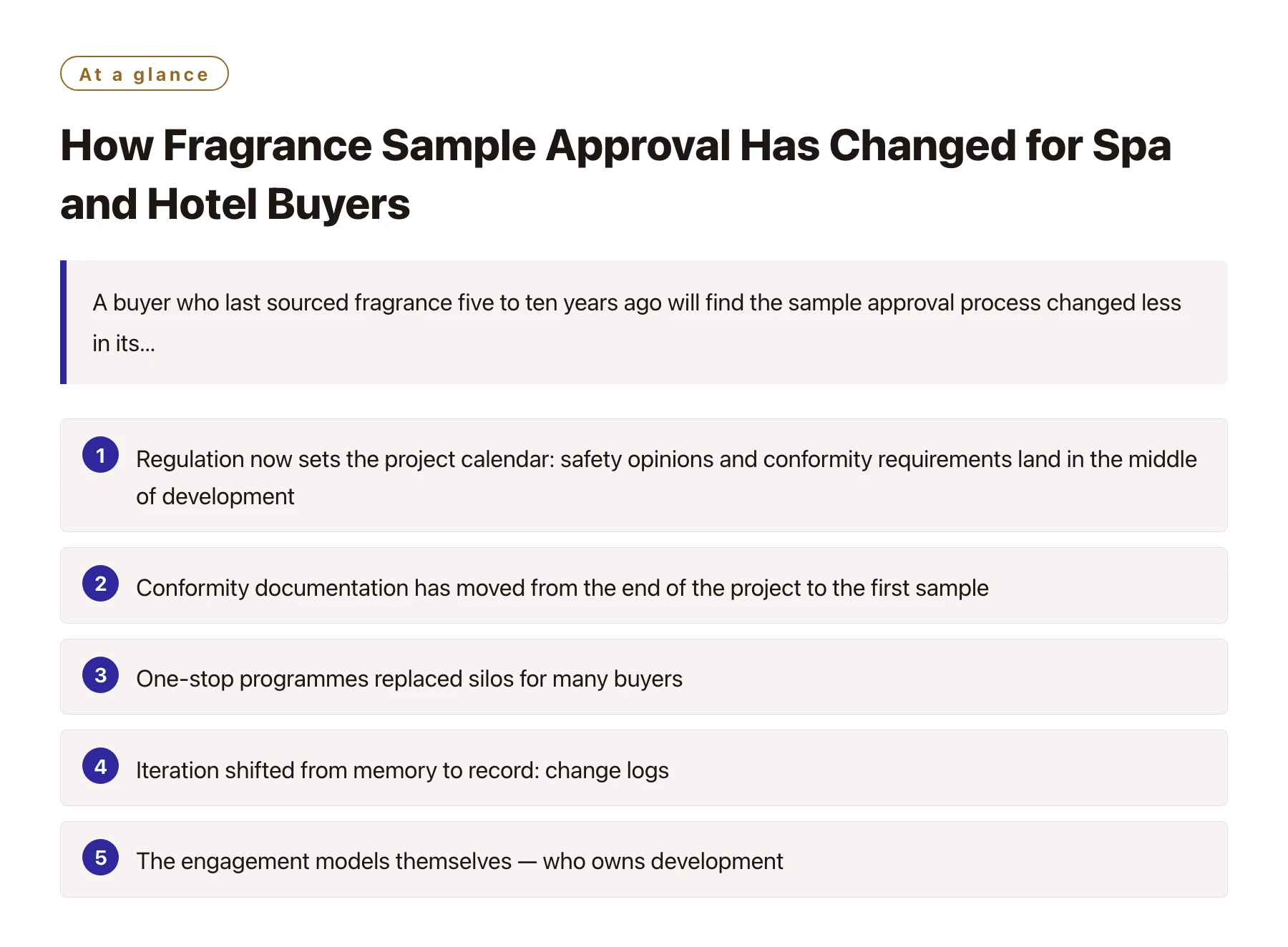
- Regulation now sets the project calendar: safety opinions and conformity requirements land in the middle of development, not at the end of it.
- Conformity documentation has moved from the end of the project to the first sample, which changes when the buyer must name its destination markets.
- One-stop programmes replaced silos for many buyers, so the approved sample now carries through to the bulk run instead of being rebuilt by a second factory.
- Iteration shifted from memory to record: change logs, retained references and batch numbers are now standard practice rather than a luxury.
- The engagement models themselves — who owns development, who owns the formula — have not moved, and they still decide how much control the buyer has.
Anyone who has been out of the fragrance sourcing loop for a few years tends to assume the industry changed its scents. It changed its paperwork instead, and the paperwork is the part that affects your budget.
The comparison below is written from a buyer's perspective — what a returning spa or hotel buyer will notice has changed, and what they should re-check before the first call.
How approval worked ten years ago
Ten years ago a typical project was more segmented. A brand worked with one company for the scent, another for the bottle, and often a third for filling and decoration, and the approved sample was a jewellery box of parts: perfume oil here, bottle there, and an assumption that someone would assemble them into the product at the end. Each hand-off meant a new quality system and a new round of trust.
Compliance worked in the background. The buyer asked for certificates, the factory produced a folder, and the folder was examined if a market raised questions. Sample approval was primarily a creative exercise: does this smell like what we agreed, and is the bottle beautiful enough.
Digital approval barely existed. Samples travelled by courier, evaluations happened in person, and the time between rounds was measured in transit days.
The buyer's leverage rested on a few fragile assets: a good relationship, a memory of what was approved, and the threat of taking the project elsewhere. Those assets still exist, but they are no longer the whole system — which is exactly the change a returning buyer profits from understanding.
What changed in recent years
Regulation became the calendar
The most visible change is that regulatory work now sits inside the development timeline instead of after it. EU authorities publish formal safety opinions on cosmetic ingredients through their scientific committee, and those opinions arrive in the middle of real product timetables [1]. A returning buyer discovers that the formula cannot be frozen until the ingredient questions for the destination markets are answered — which is why the markets now have to be in the brief from day one.
Conformity statements became normal
The industry's own bodies moved from informal reassurance to structured safety assessment, with the European industry association describing how assessment fits into a product's lifecycle rather than sitting outside it [2]. In practice, that means a first sample now arrives with a conformity statement and an ingredient declaration attached — and a returning buyer should treat a supplier that is surprised by that request as a warning sign.
One-stop programmes replaced silos
For many buyers, the biggest structural change is consolidation. Working with a single partner from formula to finished bottle means the sample you approve is the product you ship, because development, filling and testing all answer to one quality system and one set of batch records. The hand-off risk that used to live between factories has moved inside one company, where it is visible.
Iteration moved from memory to record
Approval discipline professionalised. Change logs, single sign-offs, retained references and batch numbers are now expected practice rather than a negotiating point. The returning buyer notices this at the first disagreement: the conversation now starts from a document, not from what someone remembers smelling.
Then versus now, at a glance
| Stage | Five to ten years ago | Now |
|---|---|---|
| Destination markets | Named late, often at compliance stage | Named in the brief, checked at the first sample |
| Documentation | Certificate folder at the end | Conformity and ingredient pack with the first sample |
| Supplier structure | Separate scent, bottle and fill partners | One-stop programmes for many buyers |
| Between-round loop | Courier transit and in-person meetings | Digital evaluation with documented change requests |
| Approval record | Memory and email chains | Change logs, retained reference, batch numbers |
Read the last two rows as one story: the process got both faster and more documented, which sounds contradictory until you notice that the documentation is what makes the speed safe.
What has not changed
The models have not moved. The Xuelei OEM/ODM distinction — who owns development and the formula — still decides how many rounds you control, who pays when a round misses, and what remains yours if the relationship ends. Every new regulation and every new tool sits on top of that unchanged decision.
The baseline discipline is not new either. Manufacturers that have been iterating for decades treated the retained reference and the batch record as non-negotiables long before any of the current tools existed; Xuelei's history is a reminder that the companies still standing after many years of projects were practising the boring version of approval all along.
If you are returning to sourcing after a gap, re-check three things before the first call: which markets are in the brief, which of your documents the supplier expects to provide versus hold, and who owns the formula under the model you choose. Everything else is detail.
Sources
- EU Scientific Committee on Consumer Safety (SCCS) —— The EU scientific committee that issues opinions on the safety of cosmetic ingredients, including fragrance allergens and their labelling thresholds.
- Cosmetics Europe —— The European trade association for the cosmetics and personal care industry, publishing guidance, positions and market information.
Frequently asked questions
What is the biggest change in fragrance sourcing for hotels?
Regulation now shapes the timeline and one-stop programmes shape the structure. The buyer names markets early, receives conformity documents with the first sample, and works with fewer factories across the project.
Do I still need to visit a factory before approving samples?
A visit is still the strongest verification, but the documentation now carries more of the burden: batch records, conformity statements and change logs can be reviewed remotely, and most buyers use a first small order as the practical audit.
Did digital approval make the process faster?
Yes, between the rounds: evaluations can be scheduled without courier waits. The creative time is unchanged; the calendar shrank by the transit days, which is why round counts matter more than ever.
Have the OEM and ODM models themselves changed?
No. The models are structural facts about who owns development and the formula, and neither regulation nor consolidation has changed them. What changed is the documentation wrapped around them.
Should a first sample now come with documents attached?
A conformity statement and an ingredient declaration at the first sample is the current expectation from serious manufacturers. If a supplier treats the request as unusual, that single data point is worth noting.
あなたのサイト、本当に速くなっていますか?
60分の無料診断で、Lighthouse だけでは見えない実ユーザーの体感を計測します。